BlinkThorLabs
Ultrasonic Parking Sensors: The Physics Nobody Questions Until It's Wrong
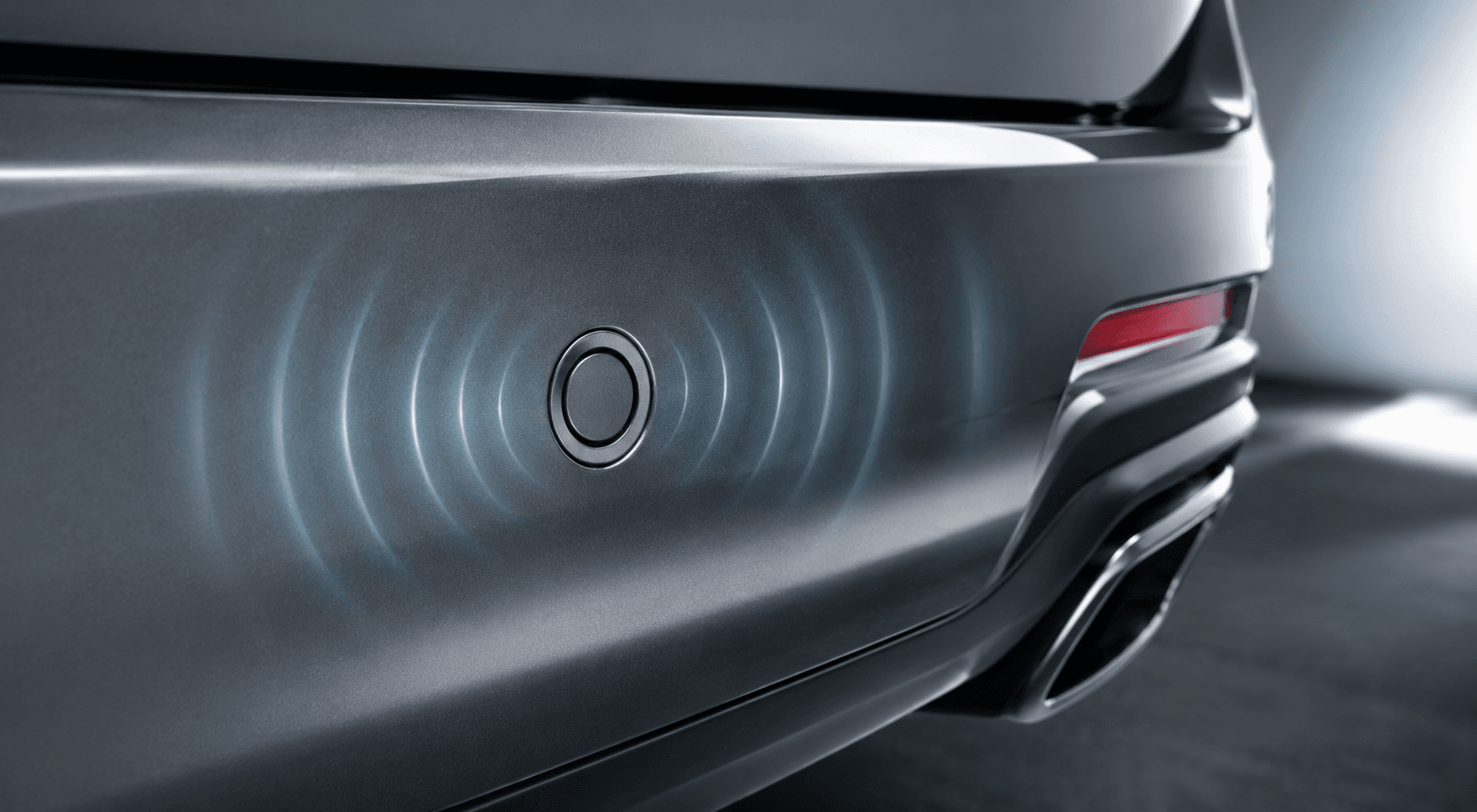
It's an echo. That's the whole idea. Here's where the idea quietly breaks.
If you've ever shouted into a canyon or an empty parking garage and waited for the sound to bounce back, you already understand, intuitively, exactly how an ultrasonic parking sensor works. It sends out a short burst of sound — well above what you can hear, but physically the same phenomenon as your shout — and listens for the echo. It measures how long that echo takes to come back, and because sound travels through air at a known, fairly consistent speed, that timing tells you how far away the thing you bounced off actually was. Half the round-trip time, times the speed of sound, equals the distance. That's genuinely the whole principle. Nothing about the sensor is doing anything conceptually more complicated than what happens when you yell into a cave and count the seconds until you hear yourself again.
The reason this simple idea is worth an entire article is that "shout and listen for the echo" quietly assumes a few things about the world that are true often enough to make the sensor reliable most of the time, and false often enough — in specific, learnable situations — to make it fail in ways that surprise engineers who've never had to think carefully about acoustics before.
Failure Mode One: The Surface That Swallows Sound
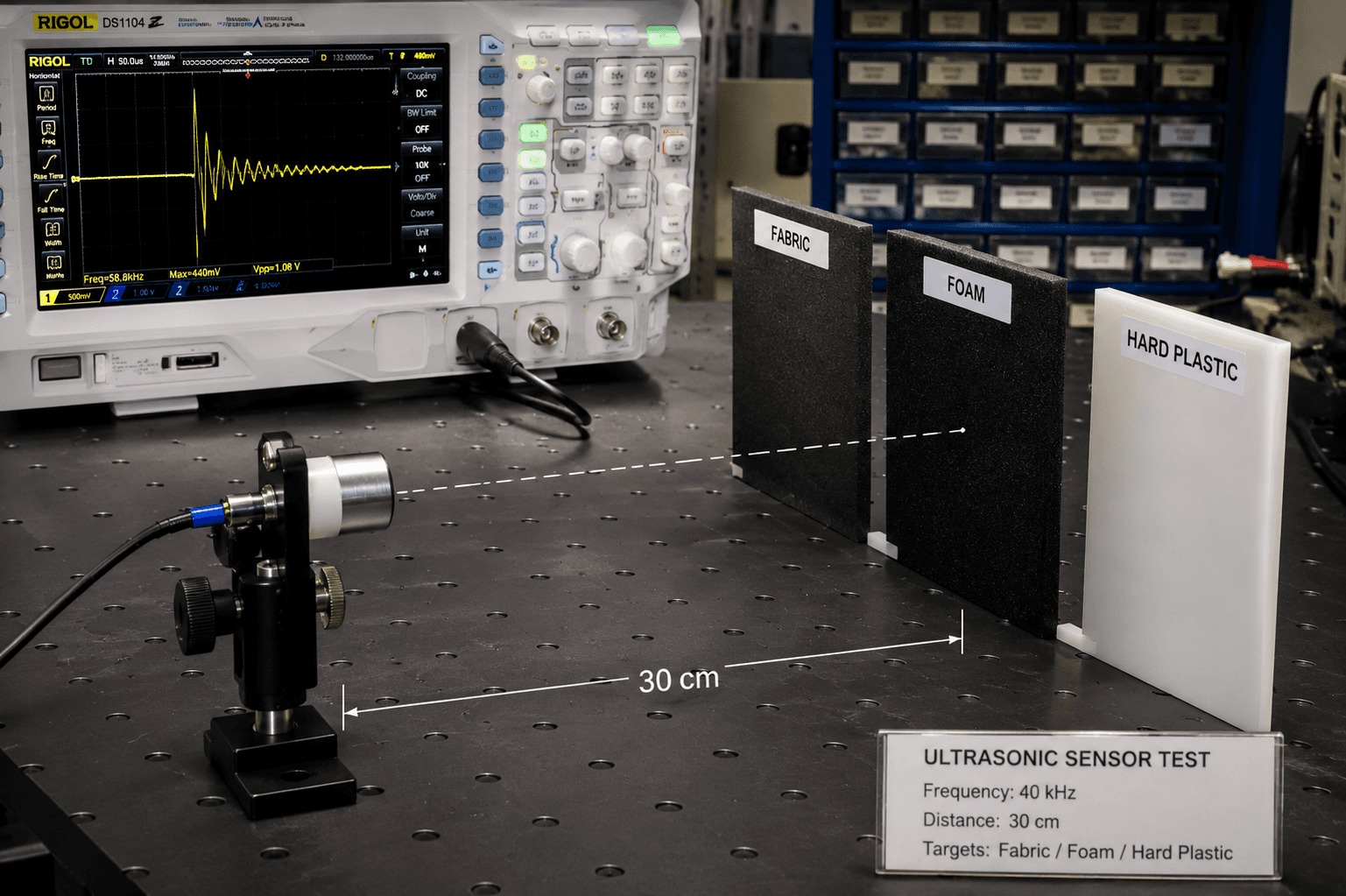
Go back to the canyon metaphor for a second. Shout at a solid rock wall, and you get a clean, sharp echo. Shout into a thick pile of snow, or a room full of heavy curtains, and you get... barely anything. Same shout, same distance, wildly different echo. That's not a flaw in your shouting. It's a property of the surface — a hard, rigid, flat surface reflects sound energy efficiently, while a soft, porous, absorptive surface converts a large fraction of that sound energy into heat instead of reflecting it, the same underlying reason a recording studio lines its walls with foam.
Where this bites an ultrasonic sensor in the real world: a pedestrian wearing a heavy winter coat, a stroller with thick fabric paneling, a foam bumper guard someone left leaning against a garage wall — all of these are, acoustically, much closer to "shouting into curtains" than "shouting at a rock wall." The sensor isn't malfunctioning when it fails to reliably detect these. It's correctly reporting the honest physical reality that very little of its emitted sound energy is coming back to it, because the target is doing exactly what absorptive foam does in a recording booth. This is worth internalizing early, because it's tempting to treat a missed detection as a sensor defect when it's often a completely predictable consequence of what the object in front of it happens to be made of.
Failure Mode Two: The Echo That Goes Somewhere Else Entirely
Here's a subtler version of the canyon metaphor. Shout directly at a wall facing you, and the echo comes straight back. Now shout at that same wall, but at a sharp angle — imagine the wall is angled away from you rather than facing you head-on. The sound doesn't bounce back to you nearly as strongly, because it reflects off at an angle roughly equal to the angle it arrived at, the same way light bounces off a mirror — and if the wall isn't facing you, that reflected sound heads off in some other direction entirely, not back toward your ears.
Where this bites an ultrasonic sensor in the real world: a car parked at a slight diagonal to the sensor, a curved bumper edge, a low sloped curb — any surface that isn't roughly perpendicular to the sensor's line of sight can reflect the emitted pulse away from the sensor rather than back to it, even though the object is very much physically present and very much reflective. This is precisely why ultrasonic parking sensors have historically struggled more with angled or curved obstacles than with flat ones directly in front of the vehicle — it's not a detection range problem, it's a geometry problem, and no amount of increasing transmit power fixes an echo that was never heading back toward the receiver in the first place.
Failure Mode Three: The Air Itself Changes the Math
This is the one that surprises people who've internalized the first two failure modes but haven't thought about the actual medium the sound is traveling through. The speed of sound in air isn't a fixed universal constant the way the speed of light in a vacuum is — it depends on the temperature of the air itself, because sound propagates through the collisions of air molecules, and warmer air molecules move faster and transmit that pressure wave more quickly. Roughly speaking, the speed of sound increases by about 0.6 meters per second for every degree Celsius increase in air temperature — a small effect per degree, but automotive operating temperature ranges are large, easily spanning 60-70°C between a cold winter morning and a sun-baked summer parking lot.
Where this bites an ultrasonic sensor in the real world: a sensor's distance calculation is built on an assumed speed of sound, and if that assumption doesn't account for actual ambient temperature, the calculated distance will be systematically off — not randomly noisy, but consistently biased in one direction, since temperature changes the propagation speed for every echo the same way. On a very cold day, sound travels slightly slower than the sensor might assume, meaning a given round-trip time corresponds to a shorter real-world distance than an uncompensated calculation would report — the sensor would report objects as being slightly farther away than they actually are. This is exactly why properly designed ultrasonic sensing systems include a temperature compensation term, often from a small onboard temperature sensor, feeding directly into the distance calculation rather than assuming a single fixed speed-of-sound constant year-round.

Why This Matters Beyond Just Knowing the Physics
None of these three failure modes are exotic edge cases you'll encounter once in a career. They're the ordinary, everyday physics of sound interacting with real-world surfaces and real-world air, and they show up constantly once you know to look for them — the stroller in the parking lot, the diagonally parked neighbor's car, the temperature swing between a cold garage and a hot afternoon. An engineer who understands these as physical phenomena, rather than as mysterious sensor quirks, ends up in a fundamentally different position when debugging a field complaint: instead of reflexively suspecting a defective unit, you can ask "was the surface absorptive, was the geometry oblique, was there a large temperature swing" — and very often, the honest answer to one of those three questions is exactly what happened, and it's not a defect at all. It's an echo, behaving exactly like an echo behaves, in a cave, in a canyon, or in front of your car.