BlinkThorLabs
Blind Spot Detection: What Drivers Get Wrong About It
Not a driver-facing FAQ. A corrective for the misconceptions that show up in our own sales decks first.
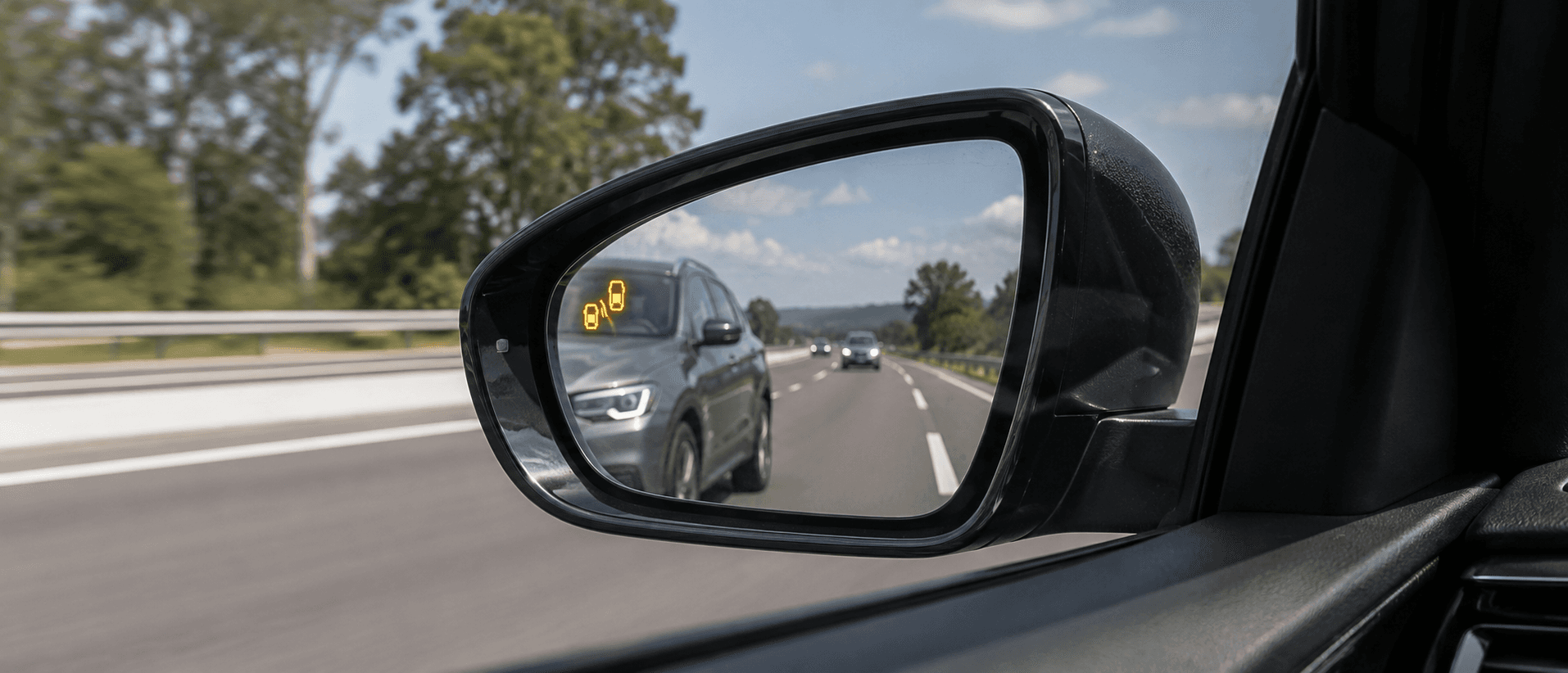
Blind Spot Detection is, on paper, one of the simplest ADAS features to explain — a light turns on if there's a car next to you that you might not see in your mirror. That simplicity is exactly why it accumulates more misunderstandings than features that sound more complicated, because everyone — sales, marketing, enterprise fleet customers, even engineers working adjacent domains — feels confident they already understand it well enough not to ask a clarifying question. Here are the three misconceptions we correct most often, written the way we'd actually correct them internally.
Misconception 1: "BSD detects any object in the blind spot"
The common belief: the system monitors "the blind spot" as a general concept, and anything back there — a vehicle, a motorcycle, debris, a shopping cart that rolled into the lane — will trigger the warning.
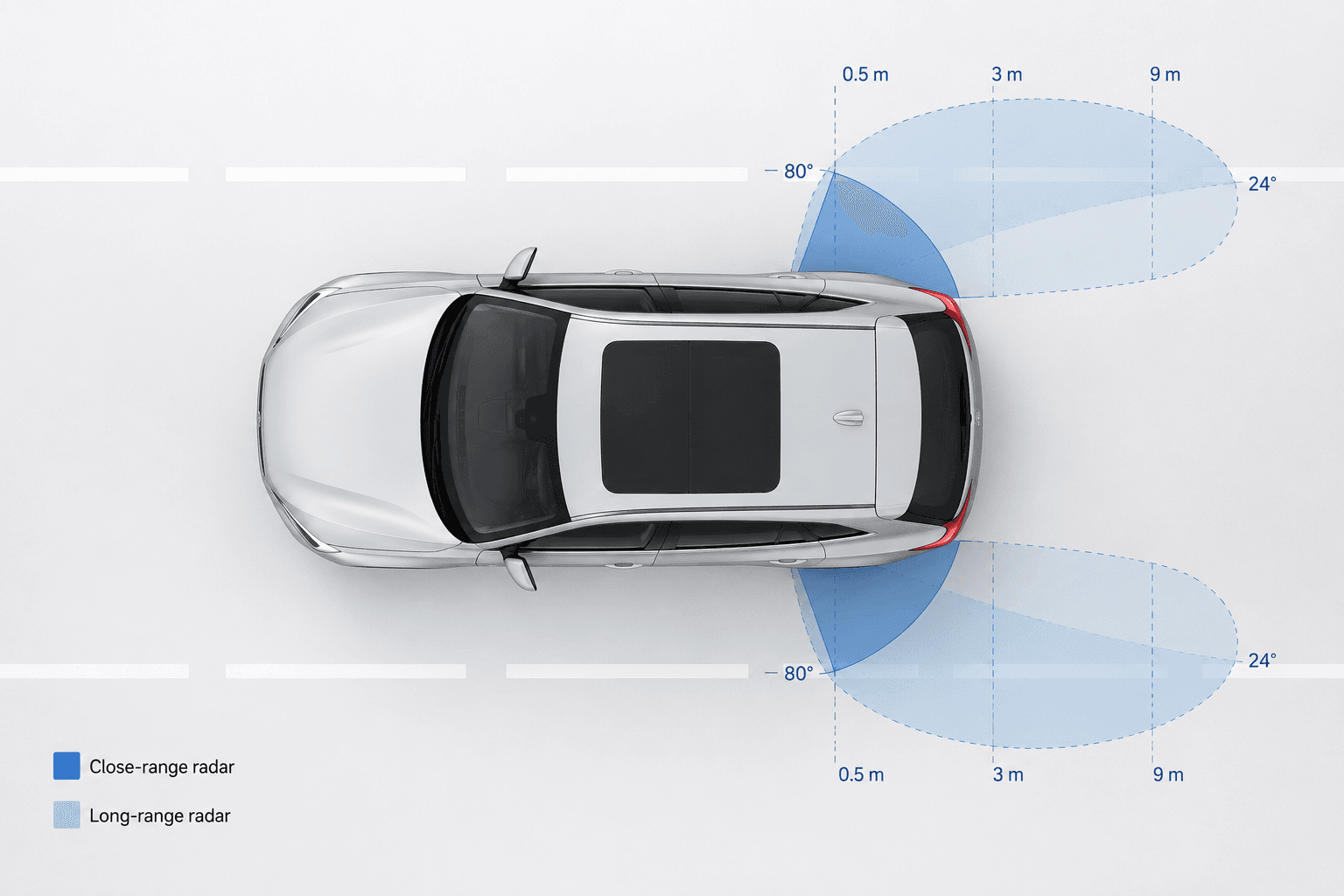
The technical reality: BSD radar units have a specific, bounded field of view and range, tuned deliberately for a particular target profile — typically vehicles and larger objects moving at speeds and trajectories consistent with traffic, within a defined angular range and distance from the sensor (commonly on the order of a few meters to a bit over ten meters behind and to the side, with a specific angular coverage that does not extend to the full physical area a human might casually call "the blind spot"). Smaller, slower, or non-vehicle objects — a pedestrian walking on a shoulder, debris, a stationary object — frequently fall outside the system's tuned detection profile, not because the sensor is defective, but because the system was specifically calibrated against the traffic scenario it's designed for, not against "everything physically present in that region of space."
Why this misconception is dangerous if left uncorrected: a sales conversation or marketing claim that implies "the system watches your blind spot" without qualification sets an expectation of general-purpose awareness the system was never engineered to provide. A customer who believes BSD will catch a pedestrian or a stray object in that zone, because nobody corrected that assumption, is a customer relying on the system for exactly the scenario it wasn't validated for — which is a considerably worse outcome than a customer who correctly understands the system's actual, narrower scope and adjusts their own vigilance accordingly.
Misconception 2: "The warning light means a car is currently sitting in my blind spot"
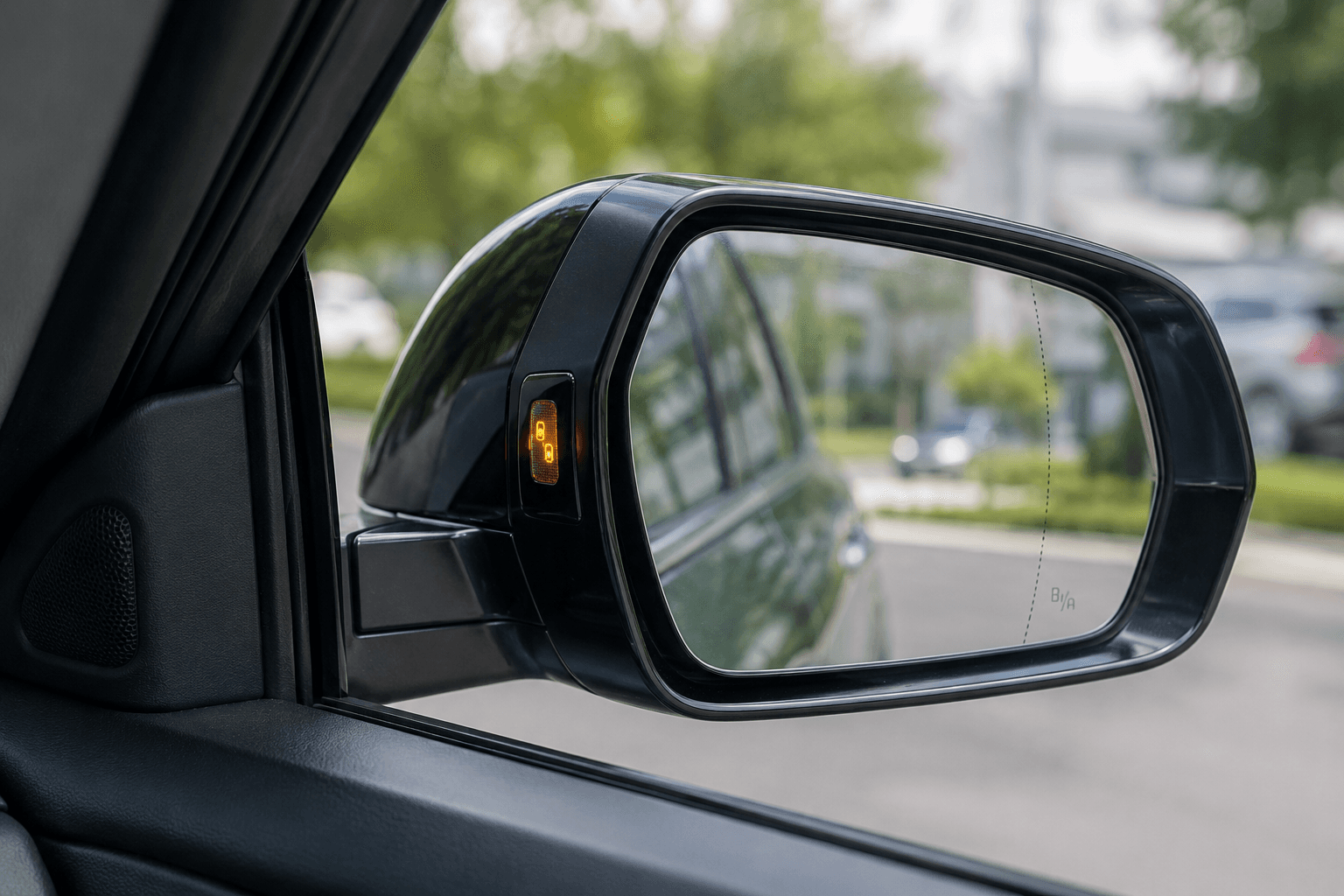
The common belief: the amber warning light illuminates specifically when a vehicle is physically alongside you, in the zone a human would call the blind spot at this exact moment.
The technical reality: most production BSD systems incorporate trajectory and closing-speed logic that extends beyond a purely static "is something there right now" check. A vehicle rapidly approaching from further back, on a trajectory and at a closing speed that would put it in the blind spot zone within the next second or two, frequently triggers the warning before it physically arrives in that zone — specifically because the whole point of the warning is to inform a lane-change decision the driver is about to make, and warning only once a vehicle has already arrived alongside you would frequently be too late to be useful for that decision. Conversely, a vehicle technically within the raw angular/distance zone but moving away, diverging, or otherwise on a trajectory that won't result in an actual close-proximity conflict may not trigger a warning at all, or may clear it faster than a purely static positional check would suggest.
Why this misconception is dangerous if left uncorrected: a driver (or, worse, an internal team member briefing a customer) who believes the light is a literal, instantaneous position indicator rather than a trajectory-informed judgment may misinterpret the absence of a warning as confirmation that a lane change is currently safe, without understanding that the system's logic is specifically trying to anticipate near-future risk, not just report current position — and may also be confused or distrustful when a warning appears to activate "too early" relative to their own naive expectation of where the other vehicle currently is, when in fact the system is behaving exactly as designed by factoring in closing trajectory.
Misconception 3: "BSD performs consistently the same way at any speed"
The common belief: the system's detection zone and warning behavior are fixed — the same physical region monitored, the same warning logic, regardless of how fast either vehicle is traveling.
The technical reality: warning thresholds and, in many implementations, effective detection behavior are commonly adjusted based on relative closing speed between the ego vehicle and the detected object, not held as a fixed, speed-independent zone check. At higher relative speeds, a vehicle can close the physical distance into a genuinely risky proximity considerably faster than at low relative speeds — the same raw distance and angular position that would be a low-urgency situation at a small relative speed differential can represent a rapidly closing, higher-urgency situation at a large one. Well-tuned systems account for this by adjusting warning timing and sometimes effective range relative to closing speed, rather than applying one static geometric zone regardless of how fast the actual physical situation is evolving.
Why this misconception is dangerous if left uncorrected: an internal stakeholder who assumes uniform behavior across all speed regimes may set inaccurate customer expectations about how the system behaves on a low-speed urban street versus a high-speed highway merge — two scenarios where the same raw distance measurement genuinely represents very different levels of actual risk, and where a system correctly tuned to respect that difference can appear, to someone holding the "it's just a fixed zone" mental model, to be behaving "inconsistently" when it's actually behaving correctly and adaptively.
Why This List Matters Beyond Being Technically Accurate
None of these three corrections are subtle or hard to explain once stated plainly — the issue has never been that the underlying engineering is too complex to communicate. The issue is that "a light turns on if there's a car near you" is such an intuitive, satisfying mental model that almost nobody feels the need to ask a follow-up question, which means the corrected, more accurate version of the explanation often never actually gets delivered to the people repeating the simplified version in front of a customer.

The practical fix isn't a more complicated customer-facing explanation — customers generally don't need the trajectory-prediction or closing-speed-adjustment details spelled out. The fix is making sure the people inside the company who are setting expectations — sales decks, marketing copy, onboarding conversations with enterprise fleet customers — actually understand these three corrections well enough not to promise more than the system delivers, because an internal misconception repeated confidently to a customer is considerably harder to walk back later than simply getting the framing right from the start.