BlinkThorLabs
RTOS Priority Inversion: A Field Guide
Priority inheritance is not automatic. Three real incidents and how we caught them.
Priority inversion is one of those bugs that every RTOS engineer has read about in a textbook, nodded along to, and then been genuinely surprised to encounter in the wild — because the textbook version is clean and the field version always has two or three extra tasks tangled into it that make the trace look nothing like the diagram. This is a field guide in the literal sense: three specimens we've actually caught, how to identify each one, and how to fix it.
The Base Definition, Quickly
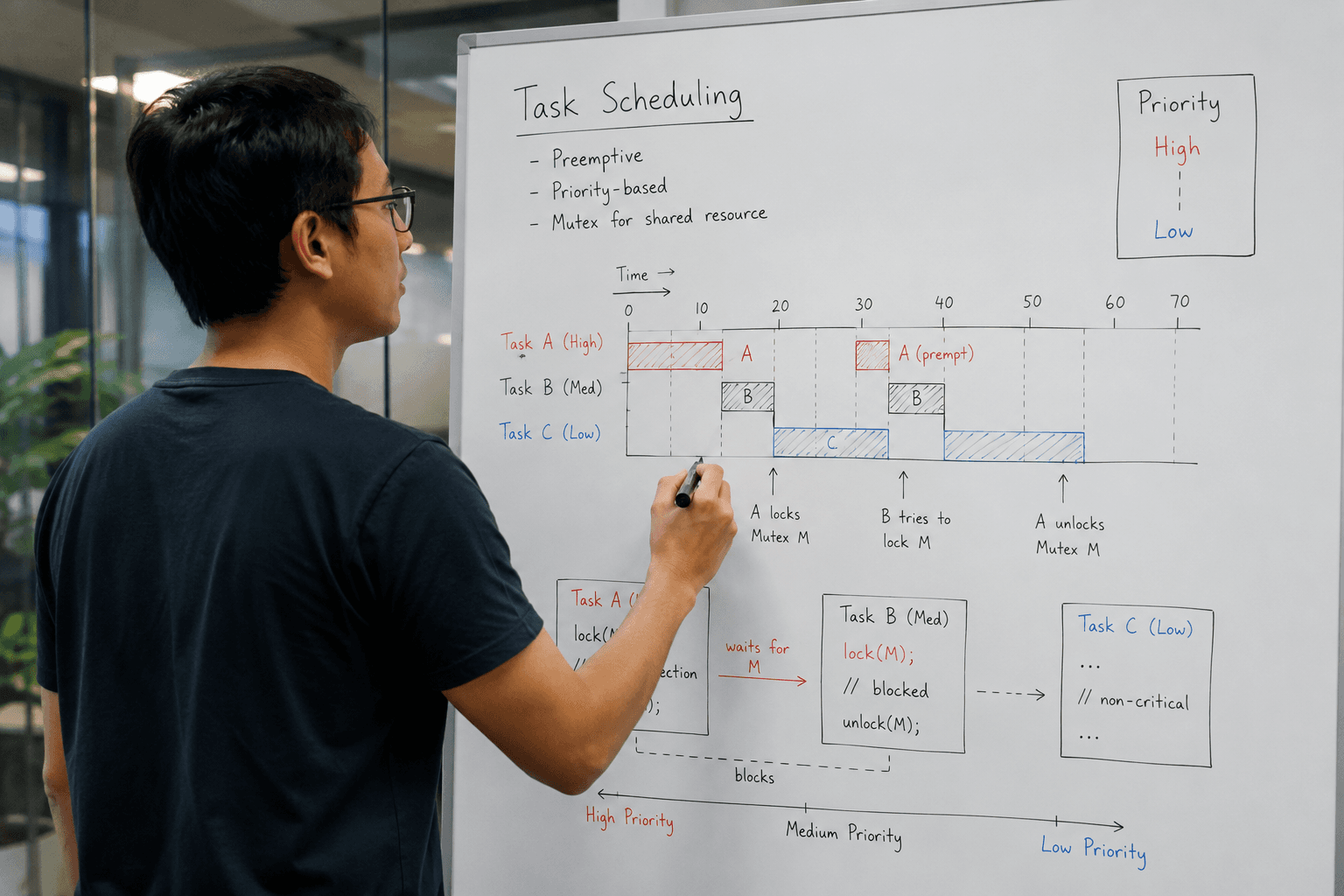
Priority inversion happens when a high-priority task is blocked waiting on a resource (typically a mutex) held by a low-priority task, and that low-priority task can't run to release it because a medium-priority task is currently occupying the CPU. The high-priority task ends up effectively waiting on a task with lower priority than itself — the priority order has been inverted by the scheduling situation, even though no single task did anything individually wrong.
The detail that catches people off guard: priority inheritance — where a low-priority task temporarily borrows the priority of whatever high-priority task it's blocking — is a specific protocol, not a universal property of mutexes. Depending on your RTOS and how you configure your synchronization primitives, you can absolutely create a standard binary semaphore or a mutex without inheritance enabled, and get all the pain of priority inversion with none of the protection. FreeRTOS's regular semaphores have no inheritance at all; its dedicated mutex type does, but only if you actually use that type instead of a semaphore for mutual exclusion — a substitution that's easy to make by habit, especially by an engineer porting code from a platform where the distinction didn't matter.
Specimen #1: The Missed Deadline
Habitat: A sensor acquisition task, high priority, expected to run every 5ms.
Identifying symptoms: Occasional missed sample deadlines, worse under specific system load conditions, no crash, no error — just a periodic task that's sometimes late by 8-12ms, which was enough to violate its real-time budget and cause a downstream Kalman filter to receive a stale or duplicated sample.
What was actually happening: The sensor task needed a mutex protecting a shared I2C bus. A low-priority logging task held that same mutex briefly to write diagnostic data. Normally this was a non-issue — the logging task's hold time was under 100µs. But a medium-priority network stack task, unrelated to either of them, would periodically run for several milliseconds processing incoming CAN frames. When the low-priority logging task got preempted by the network task while holding the I2C mutex, the high-priority sensor task — which needed that same mutex — ended up waiting not for 100µs, but for however long the network task's burst happened to run.
Diagnosis: Confirmed with an RTOS trace showing the sensor task's blocked state duration correlating directly with network task execution windows, not with the logging task's actual mutex hold time.
Fix: Switched the shared I2C mutex from a plain semaphore to FreeRTOS's mutex type with priority inheritance enabled. Once enabled, the logging task inherited the sensor task's priority the moment the sensor task blocked on it, which meant the network task could no longer preempt the logging task mid-hold — the logging task ran to completion, released the mutex, and the sensor task proceeded within its expected budget. Missed deadlines dropped to zero across two weeks of subsequent monitoring.
Specimen #2: The Unbounded Chain
Habitat: A more complex ECU with five interacting tasks and nested resource dependencies.
Identifying symptoms: This one was worse — not a bounded few-millisecond delay, but occasional stretches where a high-priority actuator control task went unresponsive for tens of milliseconds, with no consistent culprit. Standard priority inheritance was already enabled on the mutexes involved, and the delay still happened, which was the confusing part.
What was actually happening: The high-priority task was blocked on Mutex A, held by Task B (low priority). Task B was itself blocked on Mutex C, held by Task D (also low priority). Priority inheritance correctly bumped Task B's priority when the high-priority task blocked on it — but Task B, now elevated, immediately blocked again on Mutex C, and the inheritance chain had to propagate a second hop to Task D. With basic priority inheritance implemented naively (or with a shallow inheritance depth in some RTOS configurations), that second hop didn't always propagate cleanly, and Task D — still at its original low priority — could still be preempted by a medium-priority task, recreating the exact same inversion one level deeper in the dependency chain.
This is the textbook "unbounded priority inversion" scenario: with nested lock dependencies across multiple tasks, a naive single-level inheritance implementation can fail to bound the total delay, because the chain of "who's blocking whom" can, in principle, extend arbitrarily.
Diagnosis: This one took real trace analysis to untangle, because the delay wasn't attributable to a single blocking relationship — it required reconstructing the full chain (High → B → Mutex C → D → medium-priority preemption) across a multi-task trace capture.
Fix: Two changes, done together. First, we restructured the code to eliminate the nested lock dependency entirely — Task B no longer needed to hold Mutex A while also acquiring Mutex C, which was actually a design smell that had crept in over several code revisions rather than an intentional architecture. Second, for the remaining unavoidable nested-lock case elsewhere in the system, we moved to a priority ceiling protocol, where each mutex is assigned a static priority ceiling equal to the highest priority of any task that could ever lock it — a task acquiring that mutex immediately runs at the ceiling priority for the duration of the hold, which bounds worst-case blocking time to a single, predictable critical section rather than an open-ended chain.
Specimen #3: The One We Only Found Because We Went Looking
Habitat: A system that, as far as anyone could tell, had no symptoms at all.
Identifying symptoms: None reported. This is the specimen worth including precisely because it wasn't caught by a bug report — it was caught during a routine trace review using Percepio Tracealyzer, done as due diligence before a safety-relevant release, not in response to any observed failure.
What we found: A brief, low-frequency priority inversion — under 2ms, occurring roughly once every few minutes — involving a watchdog-adjacent housekeeping task and a diagnostic task. It never caused an observable failure because the affected task's actual deadline had enough slack to absorb a 2ms delay without consequence. But "has enough slack today" is not the same guarantee as "will always have enough slack," particularly as the system gained features and task load increased over subsequent releases.
Fix: We fixed the underlying mutex configuration (same inheritance-enablement fix as Specimen #1) even though nothing was currently broken, specifically because the failure mode — an unbounded design flaw that happened to currently have enough margin — is exactly the kind of thing that turns into Specimen #1's symptom the next time someone adds a task to the medium-priority band.
Field Identification: Reading a Trace for This
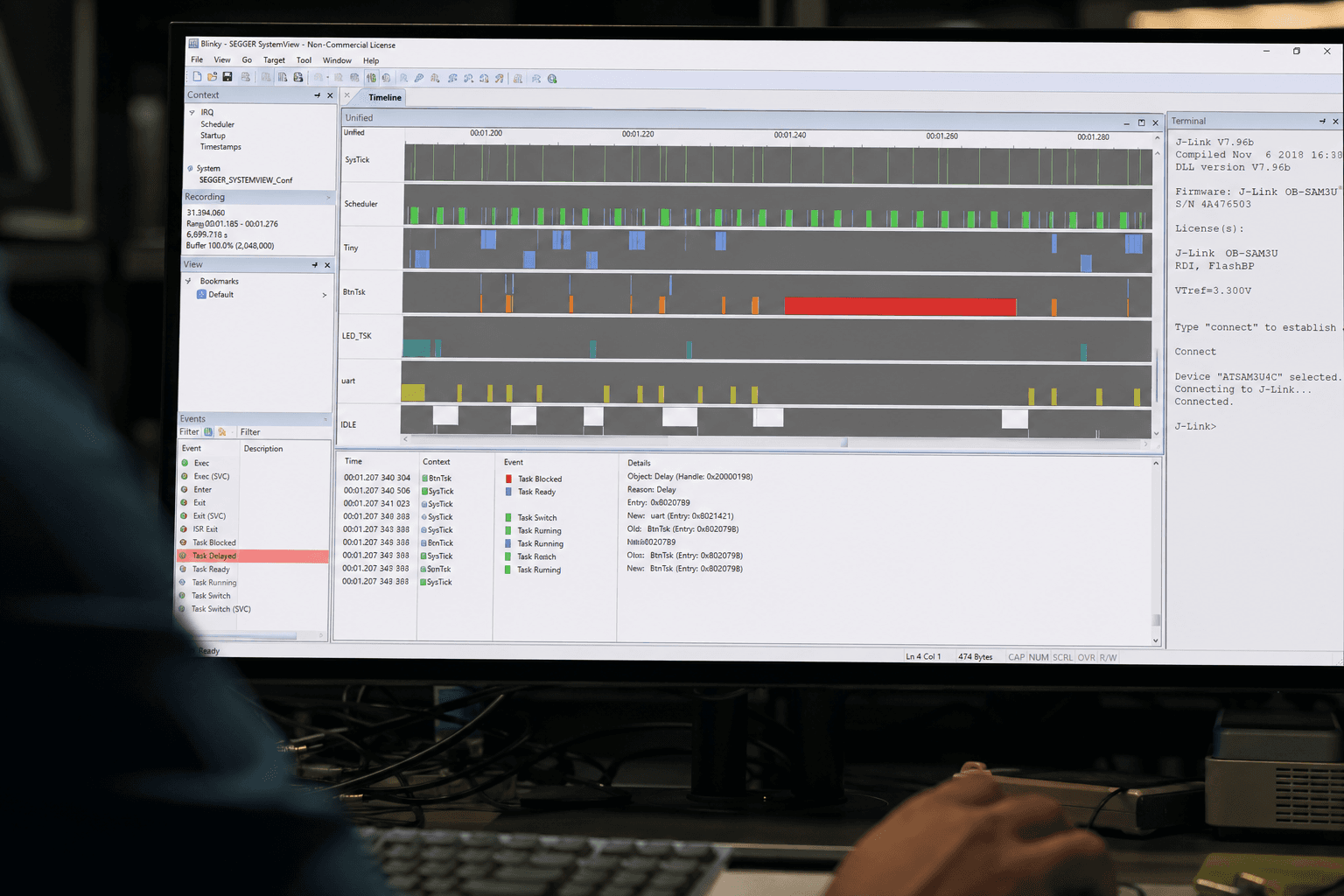
Both Percepio Tracealyzer and SEGGER SystemView visualize task states over time as horizontal timeline bars, color-coded by task, with blocking/waiting states clearly distinguished from running states. The signature to look for:
- A high-priority task shown in a blocked/waiting state
- During that same window, a task with priority lower than the blocker's target resource holder is actively running on the CPU
- The blocked task's wait duration correlates with that medium-priority task's execution, not with the actual resource holder's typical hold time
That last point is the key diagnostic move: if a high-priority task's blocking time is longer than the resource holder's own instrumented critical-section duration, something else is extending that wait, and that something else is very likely a medium-priority task in the way. Both tools let you filter to a specific mutex/resource ID and overlay all tasks that touched it, which turns "why was I blocked so long" from a guessing exercise into a direct visual read.
Best Practices, Distilled
- Default to priority inheritance mutexes for any shared resource a high-priority task might touch — treat plain semaphores as reserved for signaling, not mutual exclusion, and be explicit about this distinction in code review, since the two are easy to conflate.
- Keep critical section hold times short and bounded, ideally measured and asserted against a maximum in debug builds. A mutex held for "usually fast, but sometimes does I/O" is a mutex that will eventually cause exactly the kind of variable-length blocking that breaks real-time guarantees.
- Avoid nested locking wherever the architecture allows it. Every additional level of lock nesting is another opportunity for a multi-hop inversion chain that basic inheritance may not fully bound.
- Where nested locking is genuinely unavoidable, use priority ceiling protocol rather than relying on inheritance alone — it gives you a single, calculable worst-case blocking bound instead of a chain whose depth depends on runtime conditions.
- Run trace analysis as a standing practice on safety-relevant systems, not just as a reactive debugging tool. Specimen #3 existed with zero symptoms for an unknown length of time before anyone looked; the first time it would have produced a symptom might not have been a convenient one.
Priority inversion is not an exotic bug — it's a predictable consequence of preemptive scheduling plus shared resources, and it will find its way into any sufficiently complex real-time system eventually. The difference between a system that handles it gracefully and one that doesn't usually isn't cleverness. It's whether someone checked.