BlinkThorLabs
AUTOSAR Classic vs Adaptive: Picking the Right One Isn't About Which Is Newer
A decision framework, not a recommendation. Answer these honestly and the choice mostly makes itself.
Every few months, someone on a new project asks which AUTOSAR platform they should use, and the question is almost always phrased in a way that assumes there's a right answer independent of context — usually leaning toward "shouldn't we just use Adaptive, since it's newer?" That framing is the thing to get rid of first. Classic and Adaptive weren't built to replace each other; they were built for genuinely different classes of problem, and a project that picks the newer one for the wrong reasons ends up fighting its own architecture for the life of the program.
This isn't a recommendation. It's a sequence of questions. Answer them honestly about your actual system, not your aspirations for it, and the answer tends to fall out on its own.
Question 1: Does your system have hard real-time requirements under 1ms?
If yes — lean Classic.
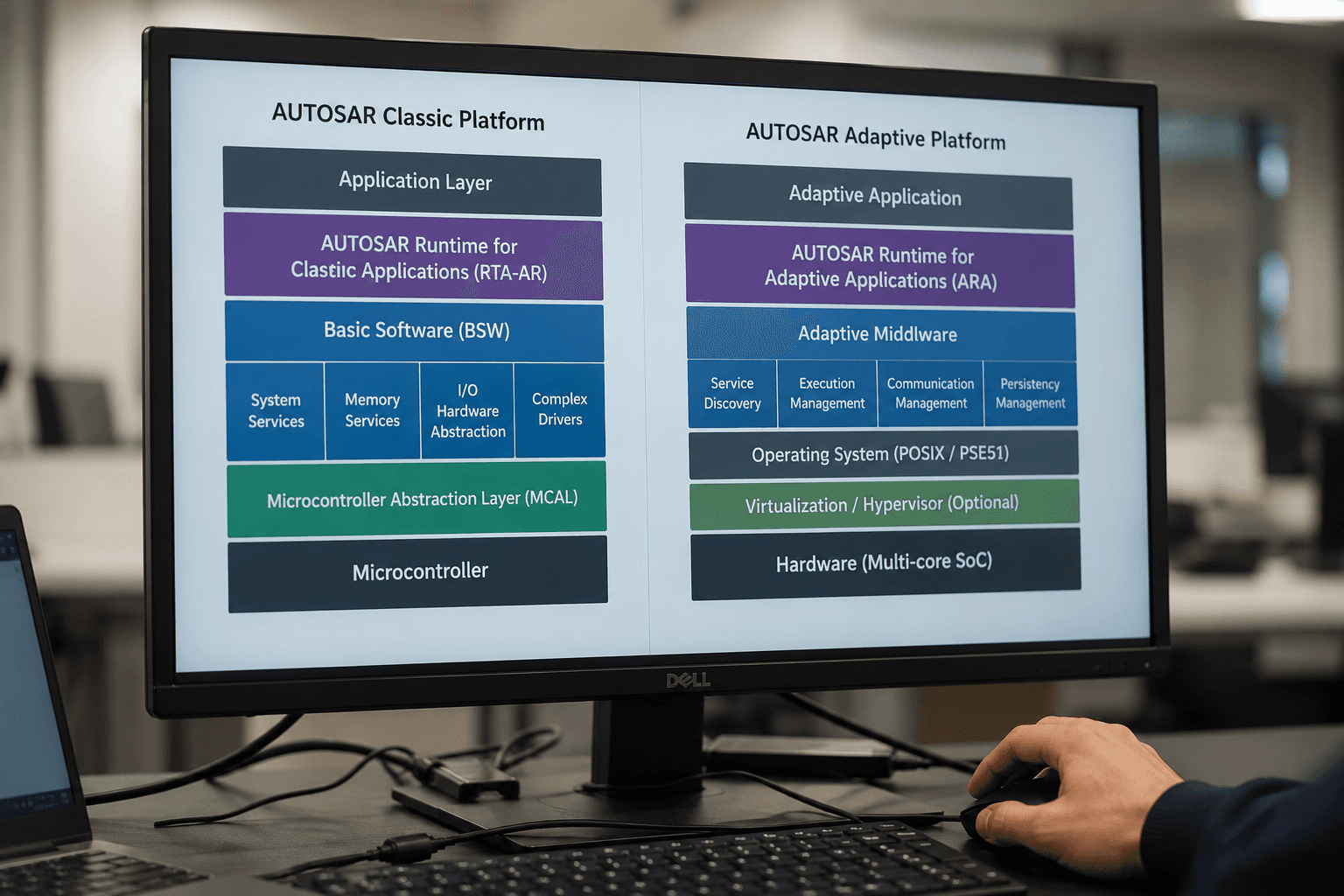
AUTOSAR Classic runs on a statically configured, deterministic OS (OSEK/VDX-derived), where task scheduling, interrupt latency, and worst-case execution time are all things you can bound and verify at design time, not just measure and hope hold up in the field. This is what makes it the default for anything genuinely safety- and timing-critical at the lowest level — brake control, powertrain, steering — where "usually fast enough" isn't an acceptable answer and you need "provably fast enough, every time, including worst case."
Adaptive AUTOSAR runs on a POSIX-based OS (typically Linux or QNX) with a service-oriented architecture designed for flexibility and dynamic composition. It can be fast — genuinely fast, often fast enough for many perception and planning workloads — but it does not give you the same class of deterministic, statically-analyzable worst-case timing guarantee that Classic's design starts from. If your control loop genuinely needs sub-millisecond, provably-bounded response, Classic is answering a question Adaptive's architecture wasn't built to answer in the first place.
If your actual timing requirement is closer to tens of milliseconds — common for higher-level planning, HMI, or perception fusion — this question stops being the deciding factor, and you should move to the next one.
Question 2: Do you need to run complex, evolving AI/ML workloads?
If yes — lean Adaptive.
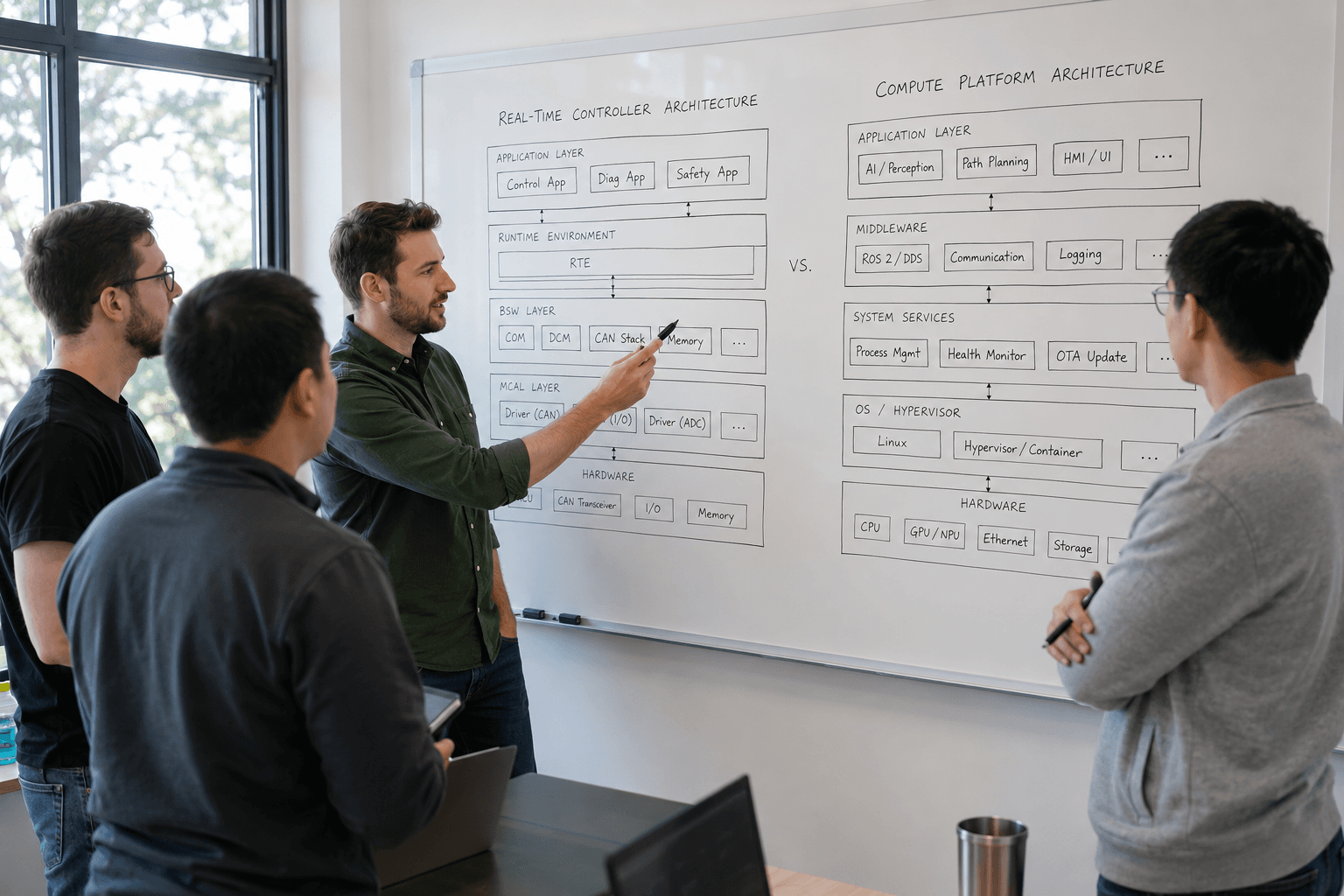
This is where Adaptive's architecture genuinely earns its reputation. It runs on a general-purpose OS that supports the same runtime environments your ML models were likely developed against — meaningfully easier integration with frameworks like TensorRT, ONNX Runtime, or vendor-specific inference SDKs, without needing to port a research-grade ML pipeline down onto a real-time OS never designed to host it. Adaptive's service-oriented, dynamically composable architecture also fits how AI/perception software actually evolves in practice — models get retrained, replaced, and updated on a cadence that doesn't match a statically-configured Classic BSW stack's typical update cycle.
Classic can run inference workloads — plenty of production ADAS systems have a Classic-based domain controller calling out to a dedicated inference accelerator — but Classic itself isn't where you'd want to host a rapidly-iterating, framework-dependent ML stack. You'd typically end up building a bridge to a separate compute element anyway, which is a reasonable architecture, but at that point you're implicitly answering this question with "Adaptive (or something Adaptive-like) for the AI workload, Classic for the control loop," which is often exactly the right answer — see the combined-architecture note at the end.
If your AI/ML workload is a fixed, rarely-updated model (a well-validated, infrequently-changed classical CV algorithm, for instance) rather than a fast-iterating research-adjacent pipeline, this question matters less, and Classic's more constrained but more deterministic environment may still be entirely workable.
Question 3: Is your compute and memory budget genuinely, strictly limited?
If yes — lean Classic.
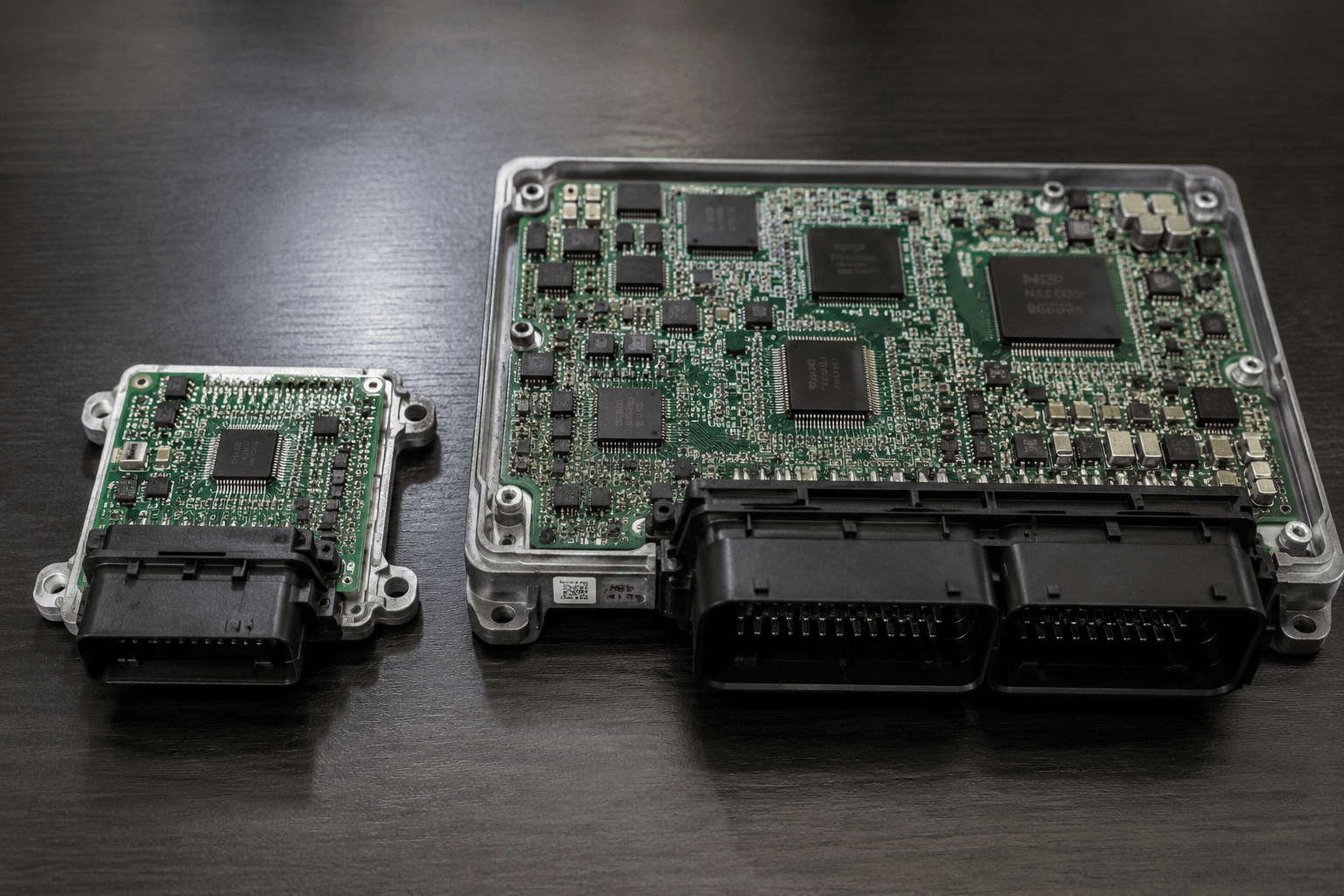
Classic AUTOSAR is designed to run efficiently on resource-constrained microcontrollers — kilobytes to low megabytes of RAM, no MMU required, no general-purpose OS overhead. If your target hardware is a genuinely cost-constrained MCU (common in body control, low-end domain controllers, or high-volume cost-sensitive programs where every cent of BOM matters), Classic isn't just a viable choice, it's often the only realistic one — Adaptive's POSIX-based runtime assumes a meaningfully more capable compute platform (an MMU-equipped SoC, typically hundreds of megabytes of RAM at minimum) that simply doesn't exist on this class of hardware, and porting Adaptive down to fit isn't a reasonable option.
If your target platform is already a high-performance SoC — the kind of hardware ADAS domain controllers or centralized compute platforms increasingly use — this constraint likely doesn't apply to you, and the deciding factor shifts to the other questions.
Question 4: Does your system need to dynamically discover, compose, or update services at runtime?
If yes — lean Adaptive.
This is close to Adaptive's founding design goal. Its service-oriented architecture (built around ara::com, a service discovery and communication middleware) is meant for systems where the set of active software components isn't fully fixed at build time — supporting scenarios like over-the-air updates that add or modify capabilities, or a centralized compute platform that dynamically manages which services are active based on vehicle state or feature configuration.
Classic's configuration model is the opposite of this by design, and deliberately so: everything is statically defined and generated at build time specifically because that static structure is what enables the deterministic timing guarantees from Question 1. Trying to bolt dynamic runtime composition onto a Classic-based system fights the platform's core assumptions rather than working with them.
Question 5: Does this system need formal safety certification at the highest ASIL levels?
This one doesn't cleanly favor either platform, but it changes how you'll need to work with whichever you choose.
Classic has a long, mature track record specifically in ASIL-D certified systems — the tooling ecosystem, the safety case documentation practices, and the industry familiarity with certifying Classic-based systems are all significantly more established, simply because Classic has been in safety-critical production for far longer. Adaptive's safety certification story is real and actively maturing, but it's a younger platform in this specific context, and you should expect a certification path with less established precedent and potentially more original safety case work required, rather than leaning on a large body of prior industry practice the way you can with Classic.
If you're pursuing ASIL-D certification and want to minimize novel safety-case risk, this consideration pushes toward Classic even independent of the timing/resource questions above — not because Adaptive can't get there, but because Classic's path is more traveled.
Putting the Answers Together
Most real systems don't land as a clean "all Classic" or "all Adaptive" answer once you actually work through these five questions honestly — and that's not a failure of the framework, it's the framework doing its job. A large share of current ADAS and SDV architectures land on a combined approach: Classic on lower-level domain controllers handling hard-real-time control (braking, steering, powertrain) where Question 1 and Question 3 both point firmly toward Classic, paired with Adaptive on a centralized compute platform handling perception, planning, and AI/ML workloads where Questions 2 and 4 point toward Adaptive — with a well-defined communication boundary between the two.
If you found yourself answering "yes" to Questions 1 and 3 but also "yes" to Questions 2 and 4, that's not a contradiction to resolve by picking one platform and forcing your whole system into it. It's a signal that your system genuinely has two different classes of software with two different sets of real requirements, and the honest architectural answer is very likely both platforms, each handling the part it was actually designed for — which, in the end, is really the entire point of going through this framework instead of just asking which one is newer.