BlinkThorLabs
Upgrading MentorPi-A1's Steering: What 11 Extra Degrees Actually Bought Us
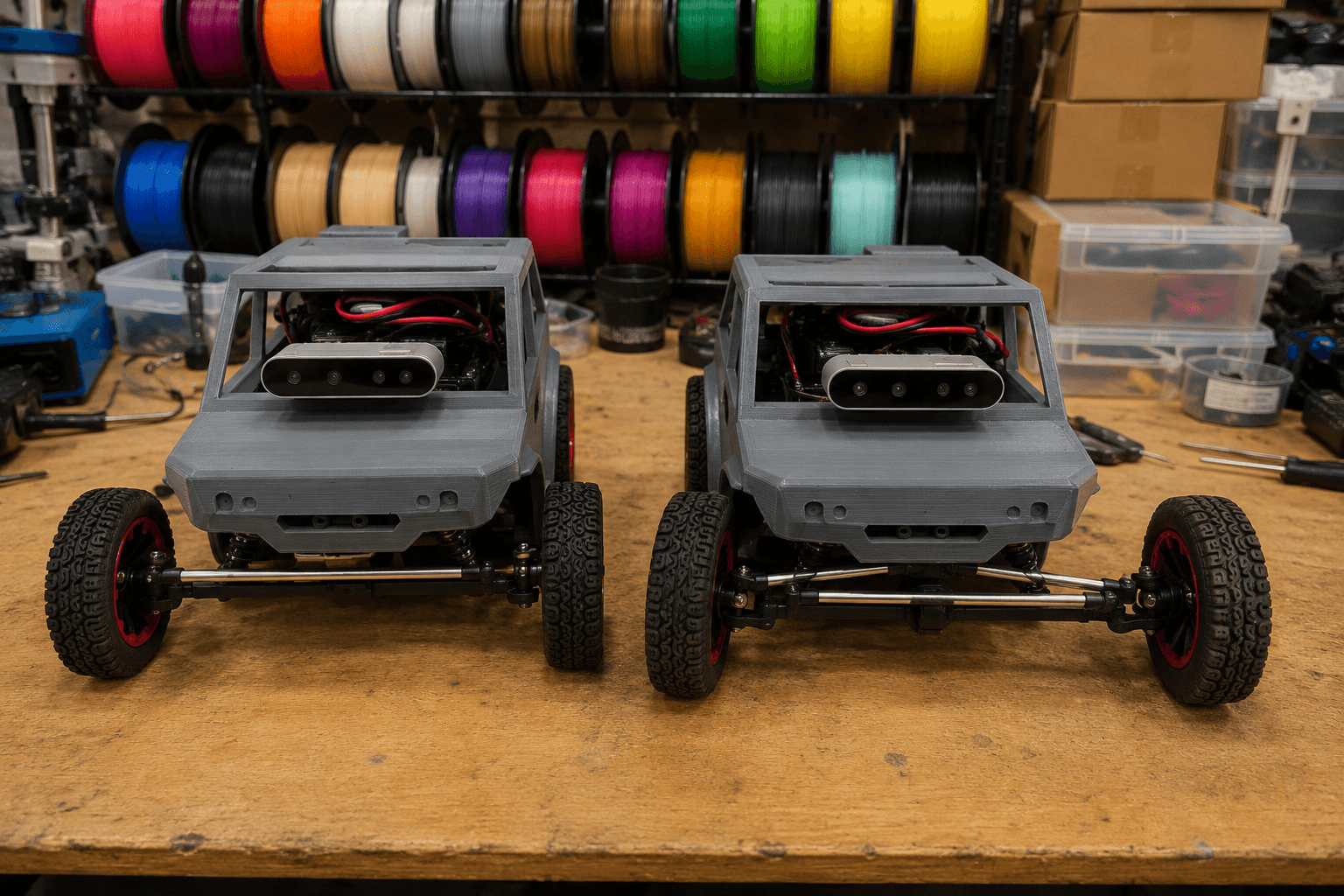
Not a victory lap. A 2024-to-2025 comparison, including the one thing the upgrade quietly broke.
The Problem the 2024 Chassis Never Quite Solved
The complaint started small and specific: on our indoor test mat, which has a genuinely constrained footprint compared to an actual parking lot, MentorPi-A1's Ackermann chassis simply couldn't complete a U-turn in one continuous motion. The 2024 hardware's front-wheel steering angle topped out at 29°, and at that angle, the chassis's turning radius was just slightly too large for the mat's actual available width — every U-turn attempt ended the same way, with the robot committing partway into the turn, running out of room, and needing to reverse and re-angle before continuing, typically two or three separate back-and-forth corrections before it actually completed the turn.
This wasn't just an annoyance in isolation — it was actively breaking the rhythm of our best demo sequence, the lane-keeping-into-autonomous-parking flow we'd been refining for weeks. A demo that's supposed to read as one smooth, continuous sequence of autonomous behaviors kept getting interrupted by an ungainly multi-point turn in the middle of it, and no amount of software tuning on the existing hardware was going to fix a limitation that was, fundamentally, mechanical — you can't route around a maximum steering angle in software.
What Actually Changed: The 2025 Steering Redesign
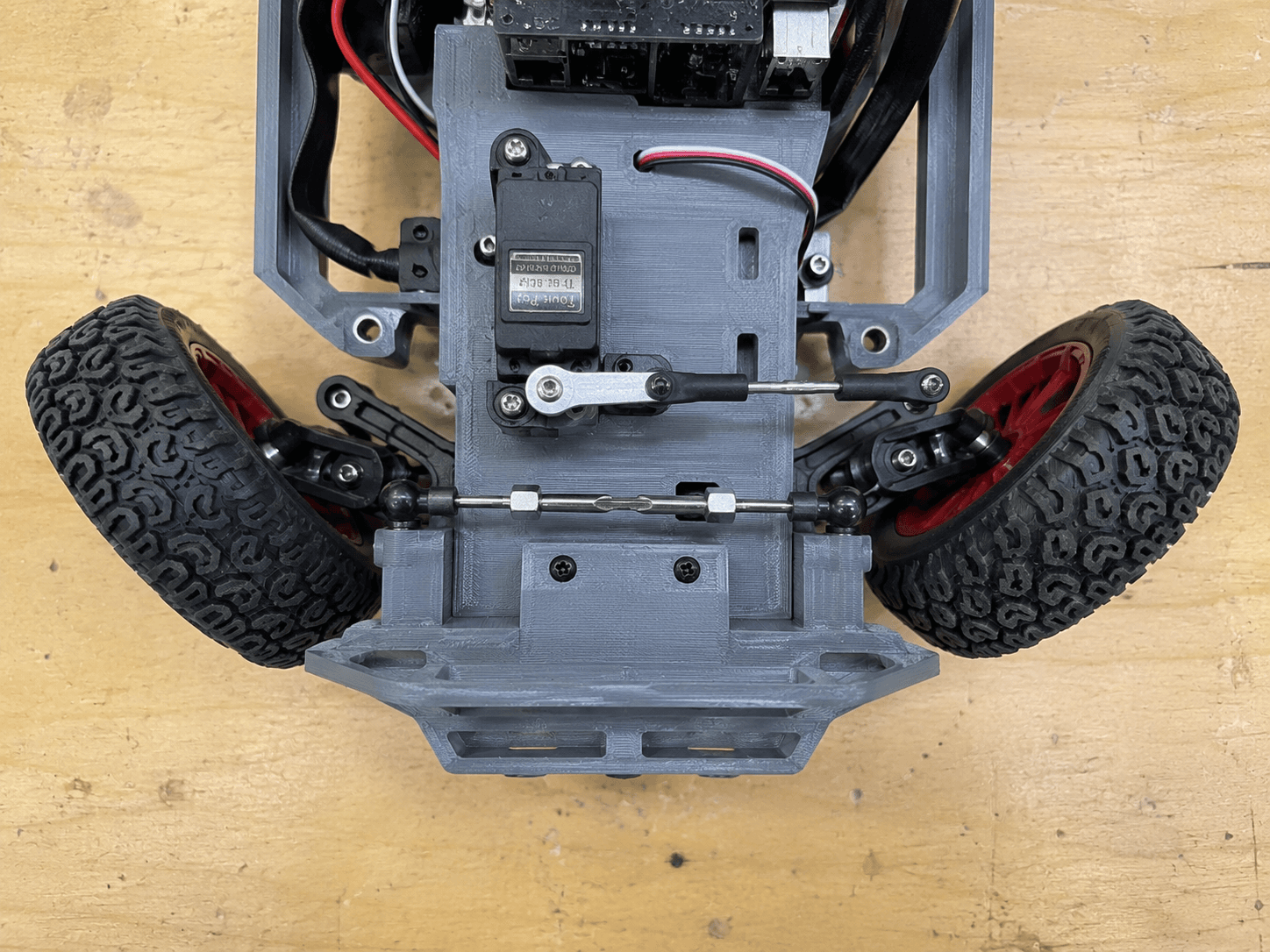
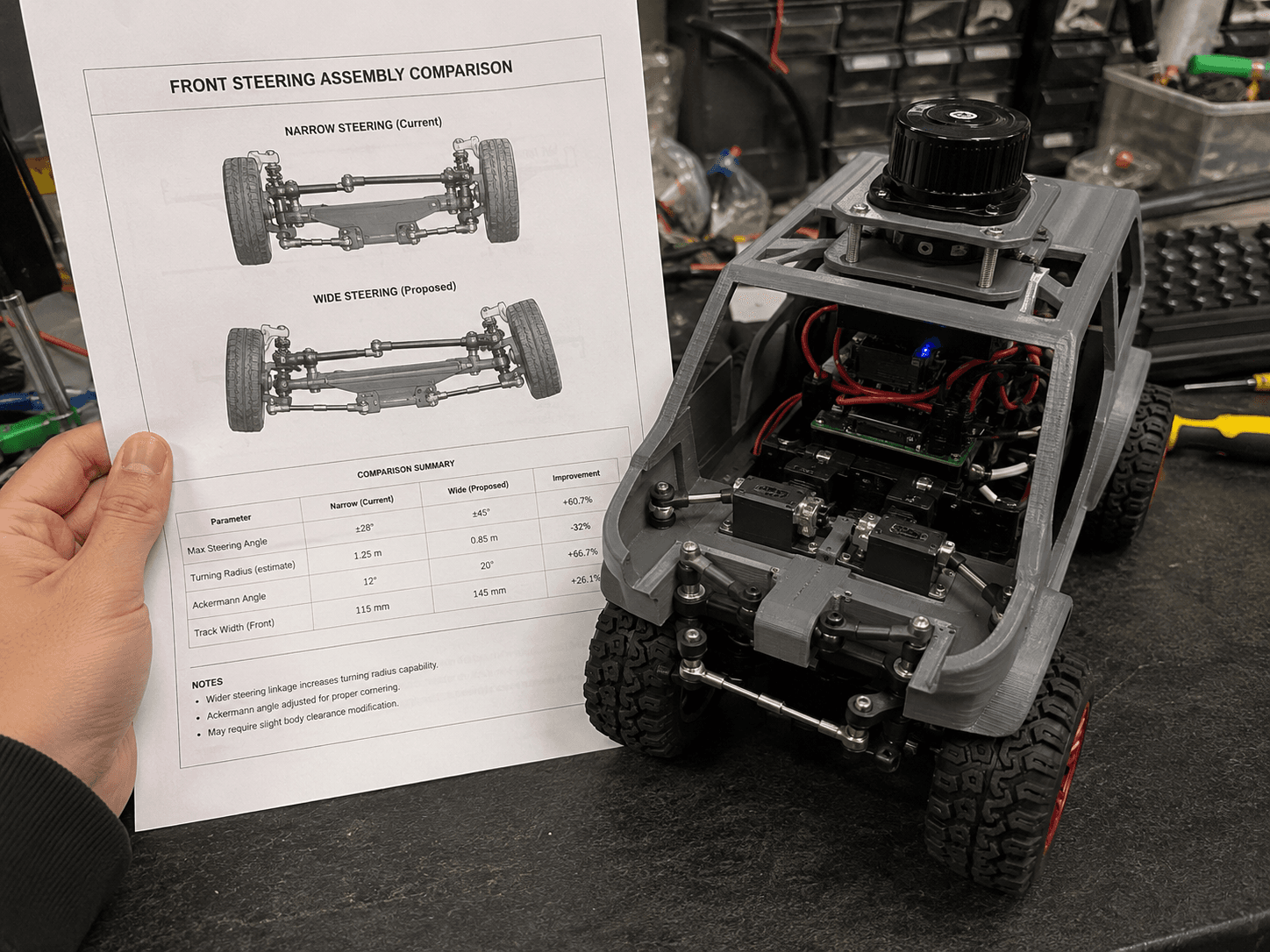
According to the internal "MentorPi Ackermann 2025 Version Upgrade Overview" we worked from, the redesign specifically targeted this constraint: reworking the steering linkage geometry to increase maximum front-wheel steering angle from 29° to 40°. This isn't a trivial software or servo-range tweak — a meaningfully larger steering angle at the same wheelbase requires actual geometric changes to how the steering knuckles and linkage arms are arranged, since pushing a wheel to a much sharper angle changes the forces and clearance requirements throughout the whole steering assembly, not just the servo's rotational range.
The direct, calculable consequence of the wider steering angle is a meaningfully tighter minimum turning radius — for an Ackermann chassis, turning radius scales roughly with wheelbase divided by the tangent of the maximum steering angle, so moving from 29° to 40° isn't a linear improvement; the tangent relationship means the turning radius reduction is considerably more dramatic than the 11-degree angle increase alone might suggest.
What It Actually Feels Like to Drive
The honest, immediate difference, once the 2025 steering hardware was actually installed and running: the U-turn problem that had been quietly annoying us for weeks simply stopped being a problem. What used to require two or three reverse-and-correct cycles now completes as one continuous steering motion, with visible clearance to spare on our test mat rather than the razor-thin margin the 29° version had been fighting against. The lane-keeping-into-parking demo sequence, for the first time, actually reads as one unbroken flow rather than a smooth sequence interrupted by an awkward three-point turn in the middle.
Sharp curve sections of the test mat also feel noticeably more confident — the chassis can commit to a tighter arc through a curve without needing the kind of cautious, wider-swinging line the 29° geometry sometimes required to avoid running out of steering authority mid-curve. This wasn't something we'd specifically set out to fix — it came along with the wider steering range as a natural side benefit, and it was a pleasant one.
The Trade-Off We Didn't See Coming
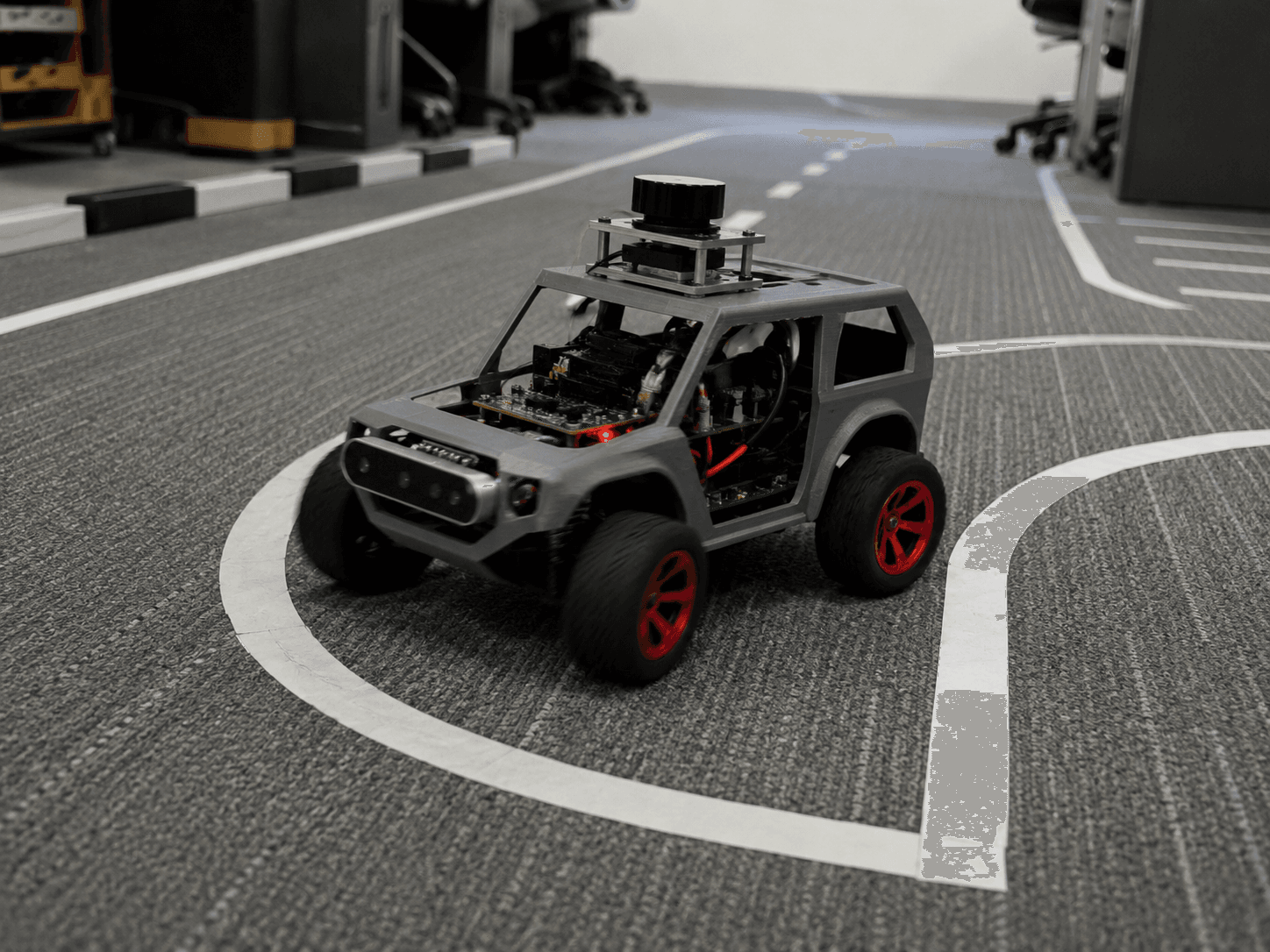
Here's the part worth being honest about rather than glossing over: the parking maneuver's steering angle calculation, baked into park_action(), was derived specifically against the 2024 hardware's geometry — the atan(-0.5061)/0.145 formula we'd tuned and verified carefully during the parking demo work wasn't just a generic Ackermann steering formula, it implicitly encoded assumptions tied to the old steering linkage's specific angle-to-servo-position relationship.
With the new 40° steering hardware installed, that same formula no longer produced quite the correct physical wheel angle for a given commanded value — the servo-to-wheel-angle relationship had genuinely shifted along with the mechanical redesign, and the parking maneuver's first few test runs on the new hardware came out visibly off, the chassis swinging into the bay at a noticeably different angle than the tuned 2024 version had produced. This wasn't a bug in any meaningful sense — the software was doing exactly what it was told, using a formula that was simply no longer describing the hardware it was running on.
The fix required going back to first principles rather than just nudging a constant: physically measuring the new steering linkage's actual angle range and servo correspondence, and re-deriving the steering angle calculation specifically for the 2025 geometry rather than assuming the old formula's structure would just need a minor constant adjustment. It didn't take long once we approached it that way, but it's a genuine reminder that a hardware upgrade to a mechanically-coupled system doesn't just improve the thing it was targeted at — it can quietly invalidate calibration work you'd done elsewhere, specifically anywhere that calibration encoded hardware-specific geometry rather than a truly generic relationship.
The Comparison, Side by Side
2024 Version | 2025 Version | |
|---|---|---|
Max servo steering angle | 29° | 40° |
Estimated turning radius (relative) | Larger — U-turn required multi-point correction on our test mat | Meaningfully tighter — clean single-motion U-turn with visible clearance to spare |
Sharp curve handling | Cautious, wider line needed to avoid running out of steering authority | Confident, tighter arc achievable without hitting steering limits |
| Original tuned formula, matched to this hardware's geometry | Required full re-measurement and re-derivation — old formula no longer physically accurate |
Overall demo flow (lane-keep → park) | Interrupted by multi-point U-turn correction | Reads as one continuous, unbroken sequence |
What We'd Tell Someone Considering a Similar Upgrade
The mechanical upgrade delivered exactly what it targeted, and the turning radius improvement was, if anything, more dramatic in practice than the raw angle numbers alone suggested — a good reminder that steering geometry improvements on an Ackermann chassis don't scale linearly with the angle change. But we'd tell anyone considering a similar steering hardware revision on their own robot to budget explicit time for re-deriving any software calibration that was tuned against the old hardware's specific geometry, rather than assuming a mechanical upgrade is purely additive. Anywhere your code encodes a hardware-specific constant — a steering formula, a servo range mapping, anything derived by measuring the old physical system rather than from a truly hardware-independent model — is exactly the kind of place a mechanical upgrade will quietly stop being correct, and it's much better to go looking for those places deliberately than to find them the way we did, watching a parking maneuver swing in at the wrong angle on the very first test run after the upgrade.