BlinkThorLabs
Inside AEB: The Millisecond Decision Between a Warning and a Brake
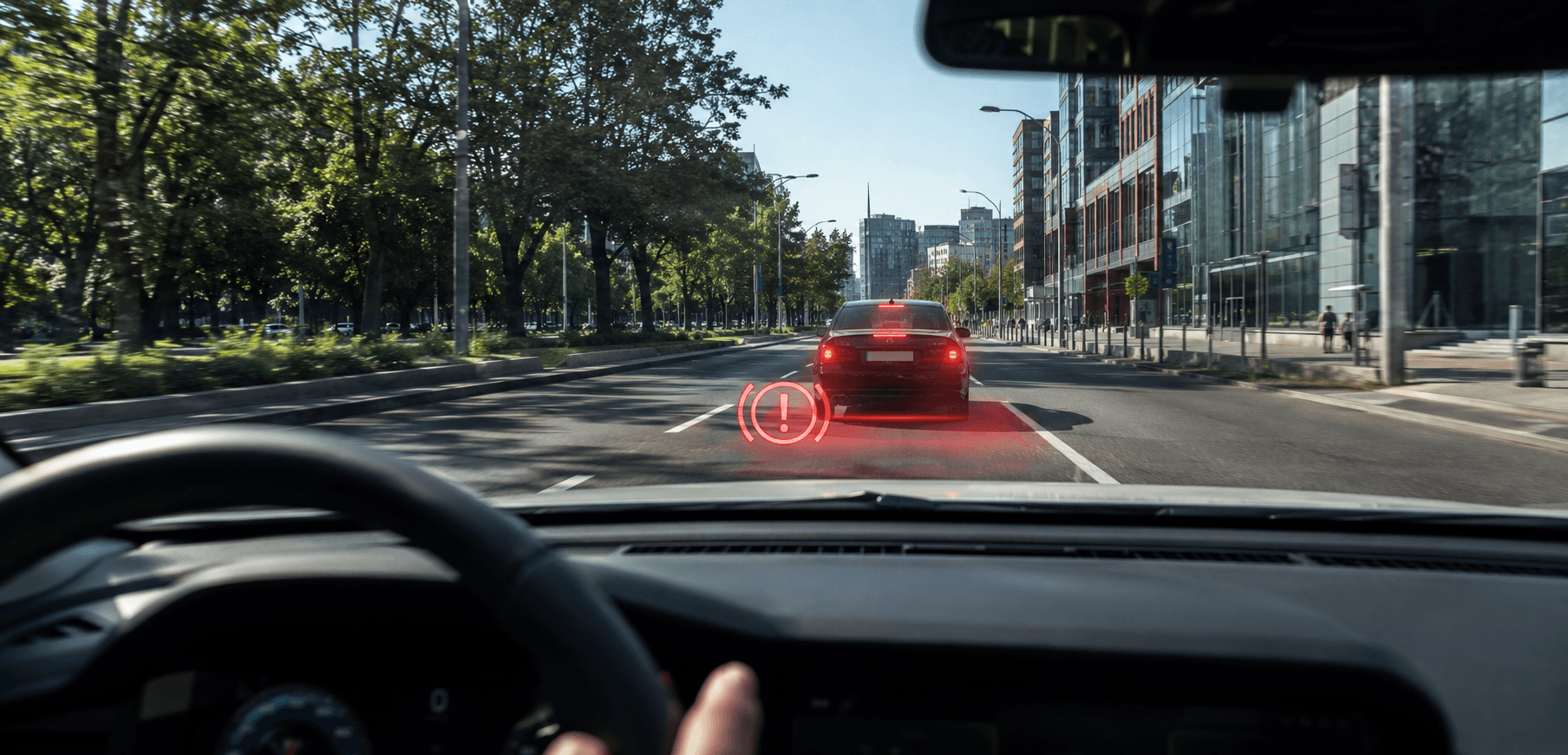
LKA/LDW, TSR, ACC, BSD — none of them carry the same weight as this one. AEB is the feature where a wrong call in either direction has real consequences.
Autonomous Emergency Braking is, functionally, one of the simplest ADAS features to describe and one of the hardest to tune correctly: detect an imminent collision, and brake before it happens if the driver doesn't. The entire system's value depends on a single quantity being computed correctly, continuously, several times a second — Time-to-Collision — and on a decision architecture that knows exactly how much to trust that number before committing to an irreversible action.
What TTC Actually Is
Time-to-Collision is the estimated time remaining before the ego vehicle and a tracked object would collide, assuming both continue their current trajectories and speeds unchanged. In its simplest form, for a lead object directly ahead:
TTC = range / closing_speed
where range is the current distance to the object and closing_speed is the rate at which that distance is shrinking (ego speed minus object speed, for a lead vehicle moving in the same direction; ego speed plus object speed, for a head-on closing scenario).
This simple form assumes constant velocity, which is rarely exactly true — a lead vehicle braking is, definitionally, decelerating, which the simple formula doesn't account for. Production AEB systems generally use a more refined estimate that incorporates relative acceleration:
TTC ≈ closing_speed / relative_deceleration (when relative_deceleration is meaningfully nonzero)
or a full kinematic solution when deceleration is significant, since the simple constant-velocity TTC can meaningfully overestimate available time in a hard-braking lead-vehicle scenario — exactly the scenario where getting the estimate right matters most.
Where the numbers actually come from: range and closing speed aren't measured directly as clean numbers — they're outputs of sensor fusion, typically radar providing accurate range-rate (Doppler-based closing speed is one of radar's genuine strengths) combined with camera-based object detection and classification providing context radar alone can't — object type, lane position, and visual confirmation that the radar return corresponds to a real, relevant object rather than a stationary roadside structure or a spurious multipath return.
The Three Tiers of Response
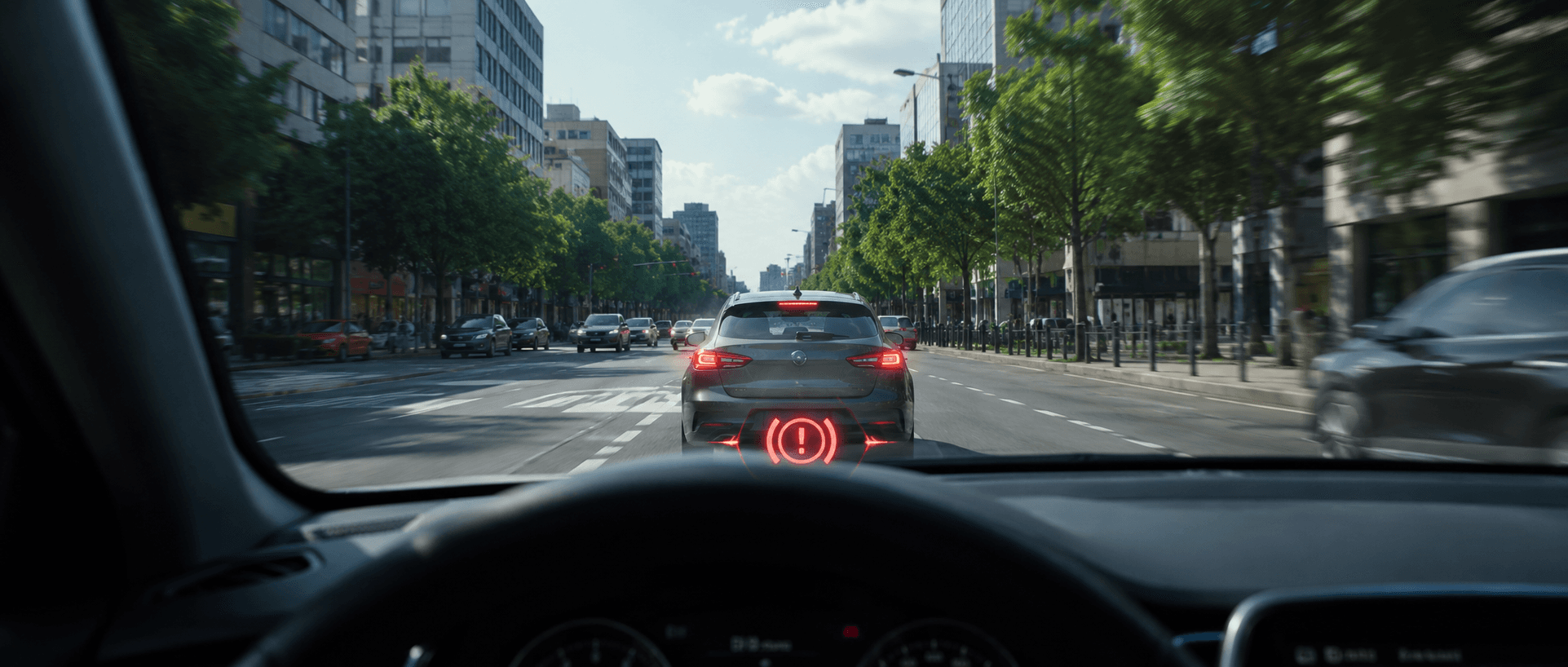
AEB systems don't binary-switch from "nothing" to "full braking." They escalate through tiers, each triggered at a progressively lower TTC threshold, because each tier carries a different cost of being wrong and a different cost of acting too late.
Forward Collision Warning (typically triggered around 2.0-2.6 seconds TTC, figures vary by manufacturer and speed regime). An audible alert and visual warning, giving the driver the first opportunity to react on their own. At this tier, a false trigger is merely annoying — a driver gets an unnecessary beep. The cost of a false positive here is low, so systems can afford to trigger warnings somewhat liberally, erring toward alerting the driver even in borderline cases.
Brake Pre-Fill / Pre-Charge (typically in the range of 1.5-2.0 seconds TTC). The system begins increasing hydraulic brake pressure preemptively — not enough to noticeably decelerate the vehicle, but enough to eliminate the mechanical slack and response lag in the braking system, so that if full braking does become necessary a fraction of a second later, it engages with minimal additional delay. This tier is a genuinely clever piece of engineering: it's nearly imperceptible to the driver if the threat resolves on its own (the false-positive cost is very low), but it meaningfully shortens the system's total reaction time if the scenario escalates.
Full Autonomous Emergency Braking (typically triggered somewhere under 1.0-1.2 seconds TTC, though this varies significantly by relative speed and manufacturer calibration). Hard, full-authority braking, applied without driver input. This is the tier where the cost of being wrong flips dramatically — a false full-braking event at highway speed is not a minor annoyance, it's a genuine safety event in its own right, given what's discussed next.
The Central Tension: False Positive vs. False Negative
This is the crux of AEB calibration, and it's worth stating plainly: an unnecessary full-braking event is not a neutral failure. A vehicle that slams the brakes on a highway because it misidentified an overhead sign gantry as a stationary vehicle creates a genuine collision risk from the vehicle behind it — a following driver, with no warning, suddenly facing a hard-braking vehicle ahead. In the false-positive direction, AEB can directly cause the exact category of harm it exists to prevent.
In the false-negative direction, a missed or late-triggered full brake in a genuine collision scenario is the failure the entire feature exists to prevent — the cost here is at least as severe, often more so, since it's the vehicle's own frontal impact rather than a rear-end risk from behind.
This is precisely why the tiered architecture exists rather than a single trigger point: it lets the system extract useful safety value at low-cost, low-certainty tiers (warning, pre-fill) while reserving the highest-cost action (full braking) for the tier where confidence needs to be highest and the TTC margin has narrowed enough that inaction is clearly worse than the residual false-positive risk. Tuning this isn't a single threshold decision — it's an explicit, continuous trade-off between two asymmetric failure costs, validated against enormous amounts of both real and synthetic scenario data before a production threshold is ever finalized.
Why Full Braking Needs Cross-Sensor Confirmation
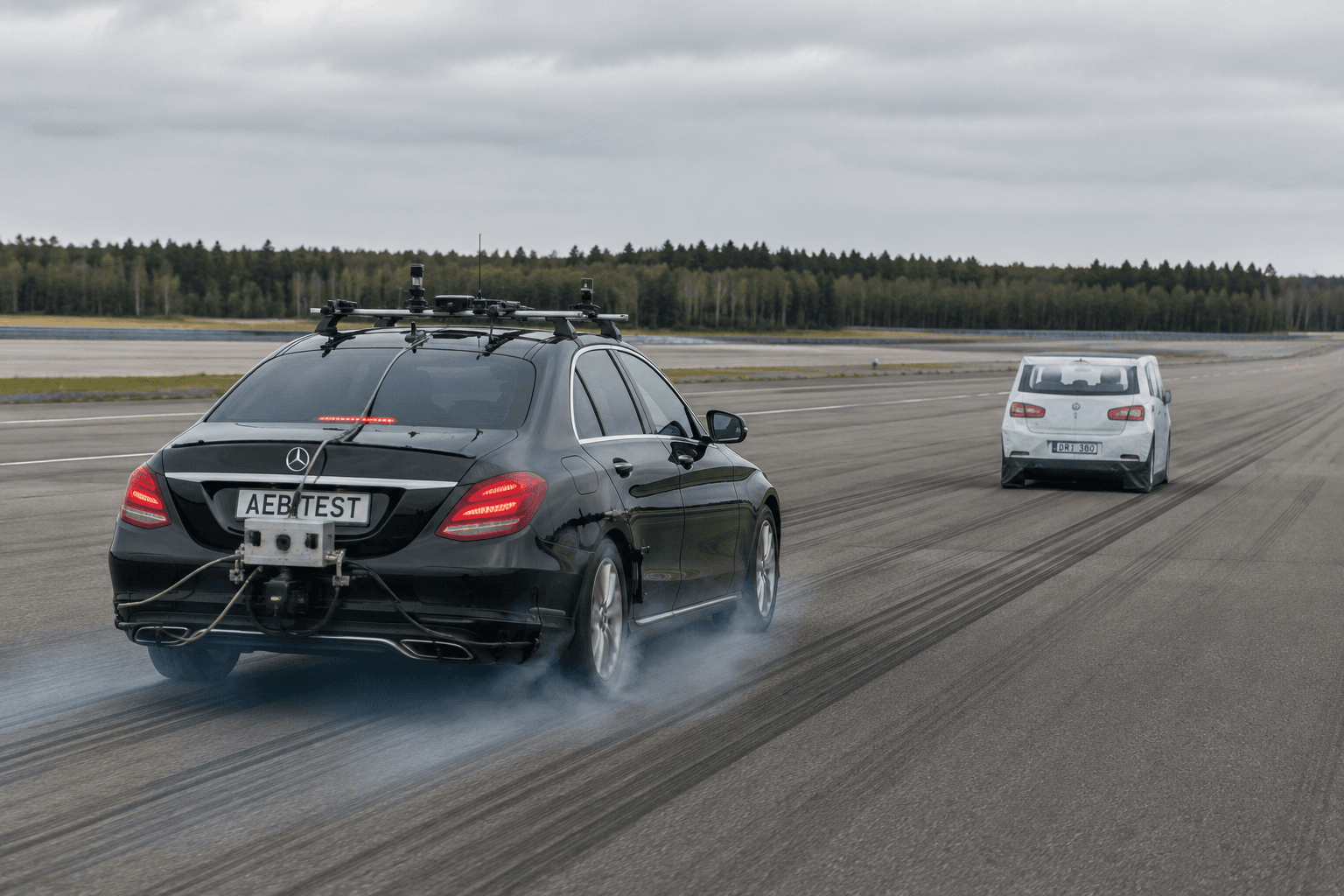
Neither radar nor camera, on its own, is reliable enough to trigger full-authority braking with acceptable false-positive rates at the confidence level this tier demands.
Radar is excellent at range and range-rate but comparatively poor at classification — a strongly reflective stationary object (a manhole cover, a metal drain grate, an overhead gantry at certain geometries) can produce a radar signature not trivially distinguishable from a real, relevant obstacle without additional context. Camera-based perception provides exactly that context — visual classification of what the object actually is, its position relative to the drivable lane, and whether it's something the vehicle would actually collide with versus something safely overhead or beside the path — but camera-based range and closing-speed estimation is comparatively less precise than radar's Doppler-based measurement, especially at longer range.
Production AEB systems require both modalities to agree, above a defined confidence level, before authorizing the full-braking tier specifically — a radar-only high-confidence detection might justify pre-fill, but rarely full braking on its own, and a camera-only detection without radar range/closing-speed confirmation faces the same limitation. This cross-confirmation requirement is precisely why AEB, as a full-authority braking feature, essentially cannot exist as a single-sensor system in any serious production implementation — the asymmetric cost of a false positive at that tier demands the kind of confidence that only agreement across independent sensing modalities can reasonably provide.
The Edge Case That Actually Keeps Perception Engineers Up at Night
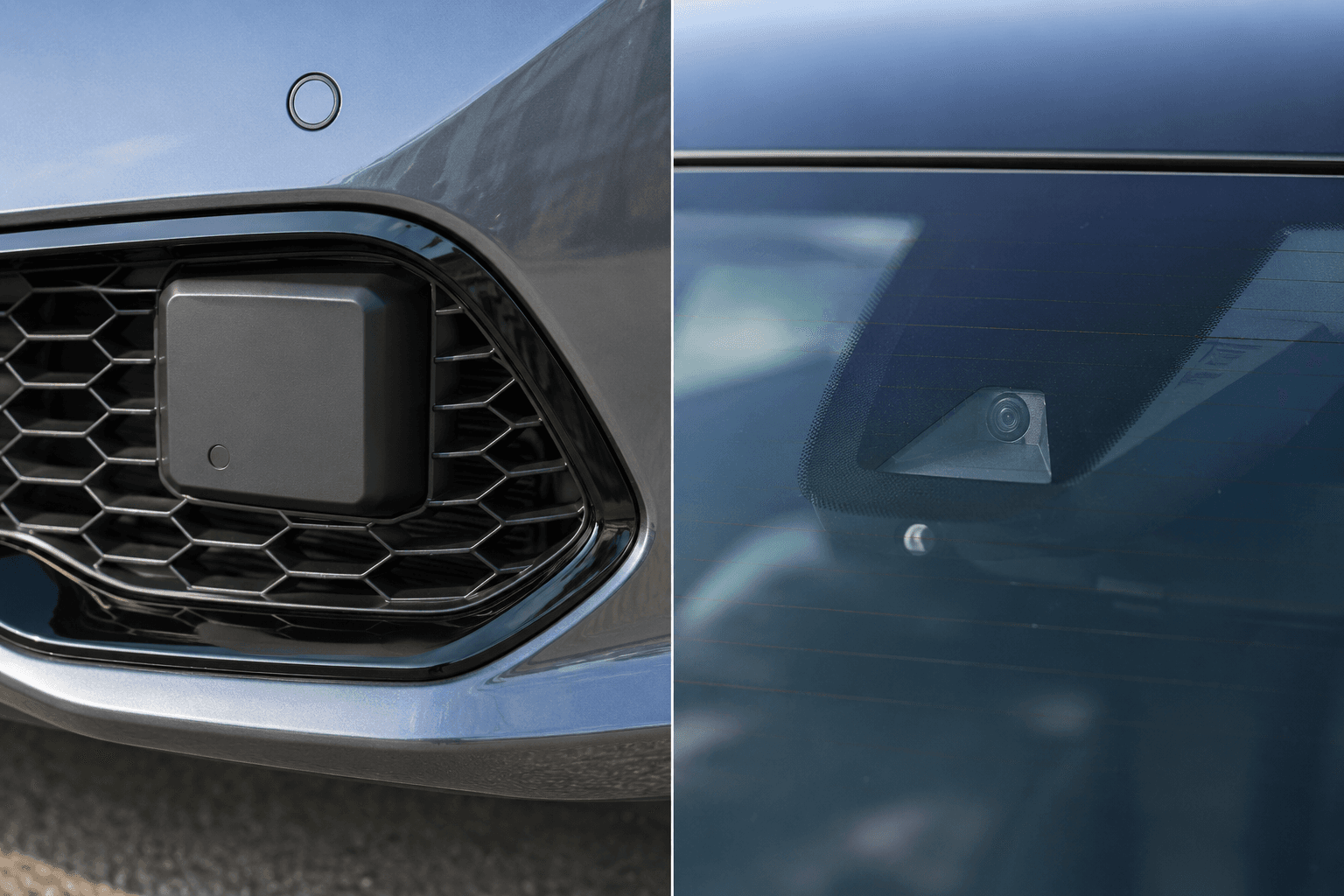
Here's a scenario that illustrates why this problem resists a purely formulaic solution: a cyclist crossing the road ahead at a slow, steady lateral speed, versus a stationary object with a radar cross-section and rough visual silhouette that could plausibly resemble a small vehicle from certain angles (a parked motorcycle partially obscured, for instance).
The cyclist case demands a fast, correct full-brake response — a slow-moving lateral target is still a collision risk if the geometry and timing line up, and cyclists are exactly the kind of vulnerable road user AEB systems are specifically validated against in regulatory test protocols. The stationary-object-that-looks-like-a-vehicle case demands the opposite: correctly recognizing that a static, off-path, or ambiguous object should not trigger full braking on its own without further corroborating evidence of an actual collision course.
Both cases can produce broadly similar raw sensor signatures for a brief window — moderate radar cross-section, a camera-detected shape with non-trivial classification uncertainty, a TTC computation sitting close to a decision boundary. What separates a correct response from an incorrect one in this specific pairing is almost entirely about trajectory consistency over multiple frames — a genuinely moving cyclist shows consistent lateral motion and a classification confidence that should sharpen as more frames accumulate, while a genuinely stationary ambiguous object shows zero lateral motion and, given enough frames, a camera classification that typically resolves toward "not a vehicle" or "not in the collision path" as the vehicle's own motion provides more viewing angles to resolve the ambiguity. This is exactly why AEB decision logic weighs temporal consistency heavily rather than acting on any single frame's classification — and exactly why the hardest edge cases in this domain are rarely about either sensor being "wrong" in isolation, but about how much accumulated evidence, across how many frames, is enough to justify the one action in the whole system that can't be quietly walked back once it's triggered.